Strategy
How to Win Tic Tac Toe: The Complete Strategy
Learn how to win Tic Tac Toe against mistakes while keeping the draw against perfect defense with a source-backed move priority system.
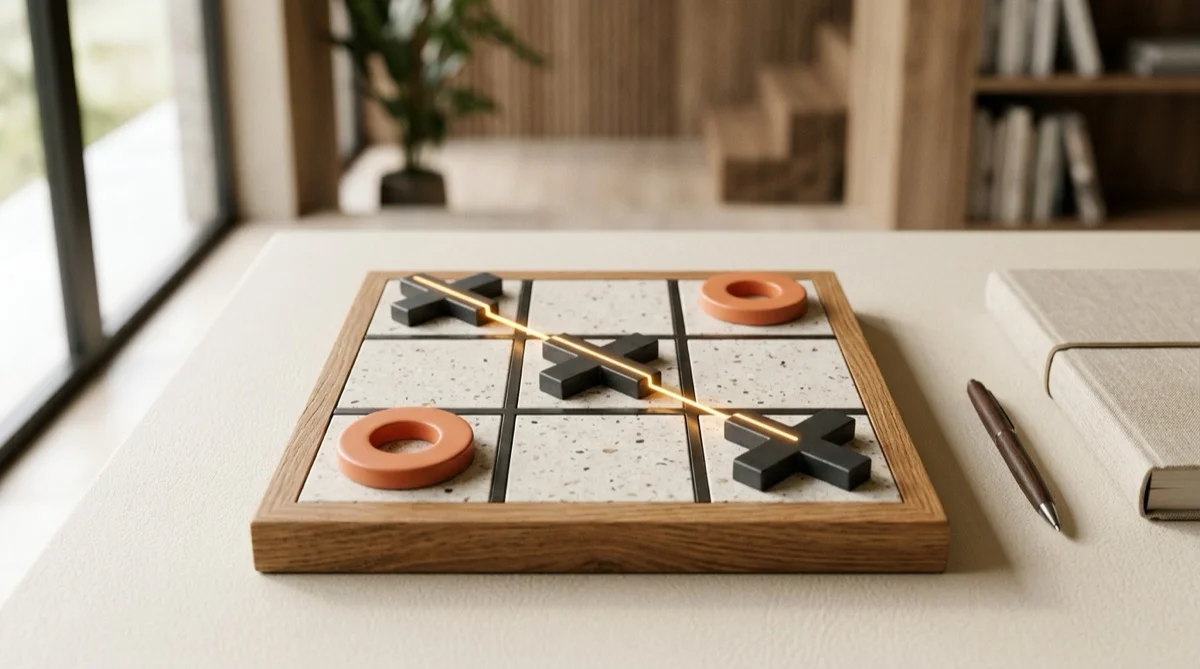
Offensive Strategy: The Unstoppable Fork
You're X. Find the move that sets up an unstoppable two-way fork.
Tap an empty square on the board to test your move, or reveal the answer.
Squares 1–9 run left to right, top to bottom
Jump to section
You cannot force a win against an opponent who plays perfectly. You can guarantee that you never lose, and you can turn a real defensive mistake into a win. That is the honest meaning of a winning strategy in a solved game.
The short answer: protect the draw first
Ordinary 3×3 Tic Tac Toe has eight winning lines. József Beck’s Tic-Tac-Toe theory describes the classic game as a draw under optimal play. So your practical target has two parts: preserve your drawing chances, then convert the opponent’s first error.
Use this priority order on every turn:
- Win now if you have two marks and one empty square in a line.
- Block now if the opponent has that same immediate threat.
- Create a fork if one move creates two different winning squares.
- Prevent the opponent’s fork before choosing a quiet positional move.
- Prefer center, corner, then edge only when no urgent tactic overrides the preference.
The first four rules are tactical. The final rule is positional. Mixing their order is why a player can choose a sound opening and still lose two moves later.
If you go first
The center is the clearest opening because it belongs to four winning lines; a corner belongs to three and an edge to two. UC Berkeley’s programming lesson lists the eight combinations and uses those line counts to explain why corners are more useful than edges when all else is equal.
If the opponent answers a corner with the center, keep scanning for wins, blocks, and forks. If the opponent chooses a weaker reply, you may gain a practical fork opportunity—but only if the exact position creates two separate winning squares.
If you go second
Your first job is not to imitate the opener; it is to remove the strongest threat. Against a corner, take the center when no immediate tactic changes the answer. Against an edge, the center gives broad line coverage. Against a center opening, a corner is the usual safe reply, followed by the same win–block–fork scan.
MATHCOUNTS’ classroom analysis shows that board symmetry reduces the opening board to three types: center, corner, and side. That is useful for learning, but later moves still need to be evaluated from the actual board rather than from the opening label.
How to create a fork
Berkeley’s strategy example defines a fork as a position with two winning moves that the opponent can block only one at a time. To test a candidate move, place it mentally, then count the empty squares that would complete your lines on the next turn. Two distinct completion squares mean you found a real fork; two lines sharing one completion square do not.
How to stop the opponent’s fork
Do not wait until the fork is already on the board. Ask what each empty square would create for the opponent. If one square gives them two winning branches, occupy it if possible. If several fork squares are available, make a forcing threat that compels the opponent to block you—provided that move does not lose immediately.
The opposite-corner pattern is a useful example: if the opponent owns two opposite corners and you own the center, an edge is often the defensive move. The point is not that edges are always strong; it is that the edge can interrupt a specific fork geometry.
Why winning tricks fail against perfect play
A trap can be genuine and still fail the “win every time” test. Many demonstrations show one bad reply, then display the fork that follows. Reverse the sequence and ask whether the defender had another legal move. If one reply keeps the game drawable, the trap is a punishment line, not a universal win.
Read the board in three passes
The easiest way to play consistently is to separate urgent tactics from positional choices. Do not evaluate every empty square with the same mental weight.
Pass one: immediate wins
Look at every line containing two of your marks and one empty square. If one exists, take it. A direct win is stronger than a fork because it ends the game immediately. The UC Berkeley strategy lesson puts this at the top of its own move rules for exactly that reason.
Pass two: immediate blocks
Now repeat the same scan for the opponent. If they can complete a line next move, block the square. This check is independent of whether your own planned move looks more active. A future fork has no value if the opponent wins first.
Pass three: future intersections
Only after the direct threats are clear should you search for a fork. Place your mark mentally in each useful empty square and count the different winning squares that would remain. Then run the same test from the opponent’s perspective. This turns “that move feels strong” into a falsifiable board calculation.
Three opening choices, three practical plans
Center opening
The center is the most connected square. It belongs to the middle row, middle column, and both diagonals. That makes it easy to see several possible lines, but it also gives the opponent a clear target: they will usually take a corner or an edge and try to limit your intersections.
If the reply is a corner, do not automatically take the opposite corner. First check whether you have a direct win, whether the opponent has created a direct threat, and whether another square prevents a fork. The board’s current threats outrank a general opening rule.
Corner opening
A corner belongs to a row, a column, and one diagonal. It gives you three lines to work with and can produce strong practical pressure when the opponent responds casually. If the opponent takes the center, look for a safe second corner or a forcing threat. If they ignore the center, check whether you can build two separate lines before they organize a block.
The corner is often described as a trap-producing move, but that description needs a condition: the trap only works when the defender chooses the losing reply. Against the best reply, the result remains a draw.
Edge opening
An edge belongs to two lines, so it creates fewer natural intersections. That makes the opening harder to play, not automatically illegal or lost. If you choose an edge, compensate with accuracy: take the center when it is safe, watch for the opponent’s fork, and do not spend a move on a slow pattern while a direct threat exists.
The line-count comparison comes from the fixed board geometry. It is a useful heuristic for an empty board, not a replacement for evaluating a populated one.
How to recognize a forcing move
A forcing move is one that sharply limits the opponent’s legal good replies. An immediate win is the strongest example. A direct threat that must be blocked is another. A fork is forcing because one block cannot answer both winning squares.
When you think you have found a forcing move, test three questions:
- Can the opponent win immediately instead of answering me?
- Can the opponent block both of my supposed threats with one square?
- Does my move accidentally create a fork for the opponent?
If the answer to any of these questions is yes, the move needs to be reconsidered. This check explains why a move that attacks one line can still be strategically bad: it may hand the opponent the tempo they need to make two threats.
A worked mental example
Imagine that you own the center and one corner. You are considering a second corner. Place that mark mentally and scan the completed board. If one empty square now completes a row and another empty square completes a diagonal, you have a fork. If both lines need the same empty square, you have only created one ordinary threat.
Now give the same candidate square to the opponent. If their mark would create two winning completions, your attractive move may be a blunder. You either need to occupy their fork pivot or choose a forcing move that makes them respond. The important skill is not remembering which numbered square appeared in a diagram; it is repeating the place–scan–undo test on a new position.
Why a drawing move can be the winning decision
Against perfect defense, the best move may be the one that preserves a draw rather than the one that looks most aggressive. That is not a contradiction. A move can be “winning strategy” in the practical sense because it prevents a loss and gives you a chance to punish a later mistake, even though it cannot force a win against a flawless opponent.
The University of Massachusetts minimax explanation formalizes this choice: a position is evaluated by the best result available when the opponent also chooses the best response. If a win is unavailable, a drawing continuation is the correct choice.
Common questions
Is the center always the best move?
It is the clearest strong recommendation because it belongs to four winning lines. It is not an automatic win, and a later tactical emergency can make another square correct.
Is the corner always better against a human?
Not always. A corner can create more practical traps against a weak reply, but the outcome depends on the opponent’s actual move. Use the corner as a practical choice, not as a promise.
Can the second player win?
The second player cannot force a win against perfect opening play, but can win after the first player makes a mistake. The second player’s job is to preserve the draw until the opponent leaves it.
Why do I lose after memorizing an opening?
Opening rules cover only the first few choices. A later missed block or fork can change the position. Restart the priority scan after every opponent move.
How can I practice?
Play the computer on the strongest setting and make the draw your first goal. Then use puzzle mode to practice recognizing wins, blocks, and forks without relying on a memorized opening.
Cheat sheet
- Every turn: check win, block, fork, and fork defense in that order.
- First player: center or corner creates the most useful intersections.
- Second player: answer the opener, then maintain the drawing structure.
- After a mistake: stop following a memorized opening and calculate the forced continuation.
- Practice: use the solver to compare your move with the position’s best result.
The goal is not to memorize one sequence. It is to see the board as eight lines, identify the most urgent line, and choose the move that preserves your result. Read How to Never Lose at Tic Tac Toe for the defensive version and What Is a Fork in Tic Tac Toe? for focused double-threat practice.